platform · live systems · Live
Arcane Ecosystem
A modular Minecraft server platform I've built over the past year, the closest thing I've come to production.
The longest thread
Everything else in this portfolio is a system I built to learn something. Arcane is the system I built to ship. It is the project I keep coming back to, most of a year of continuous work, and it runs live on a server I host and administer: a VPS with a proxy in front, a panel, and one main game server. There is no separate test box, so every deploy lands where players are. The paid store is on hold while it is rebuilt, so I’m not claiming revenue here.
Running it live is a different bar from a research repo. It means data integrity, anti-dupe tracking, hot reloads instead of restarts, and backwards-compatible migrations. This is where I learned the unglamorous half of engineering.
The engine
At the center is Arcane Sigils: an 81,000-line, 471-file ability engine. Players socket “sigils” into armor and weapons; 77 registered effects fire on 26 trigger types (attack, defense, kills, bow hits, a passive tick, and more) with conditional activation by health, biome, or time of day.
A piece I built, shipped, and later cut shows what running real software is like: a YAML flow-graph DSL and visual node system that let a server owner who does not write Java author entirely new mechanics by wiring effects together. It worked. But the partners it was meant for did not end up using it, so I removed it, about 4,300 lines, rather than carry a feature nobody touched. The engine still carries a custom particle shape system, 1.8-style combat on a 1.21 server, and packet-level work through ProtocolLib.
It also runs combat bots: fake players driven by a rule-based state machine, with difficulty tiers that each set 27 combat tunables. They fight with the same sigils players use.
The platform
The addons and plugins share one world, and the discipline that keeps that maintainable is a hard rule: each one reaches another’s data only through its public API, never by reaching into internals. They integrate; they do not entangle.
- Economy: vaults, a market with a polling website bridge, CS:GO-style cases, and item dupe-tracking, across 19 MySQL tables.
- Legions: factions, chunk-claimed territory, relations, power, and banks.
- Dungeons: hand-built PvE dungeons with wave and boss orchestration and party runs, backed by the deepest test suite in the project.
- WarZone: capturable points, outposts, generated caves for mining, and a sandstorm event.
- Duels: ranked ELO, kits, arenas, and seasonal rewards.
- Bots and Gardens: the combat bots above, and a newer farming addon.
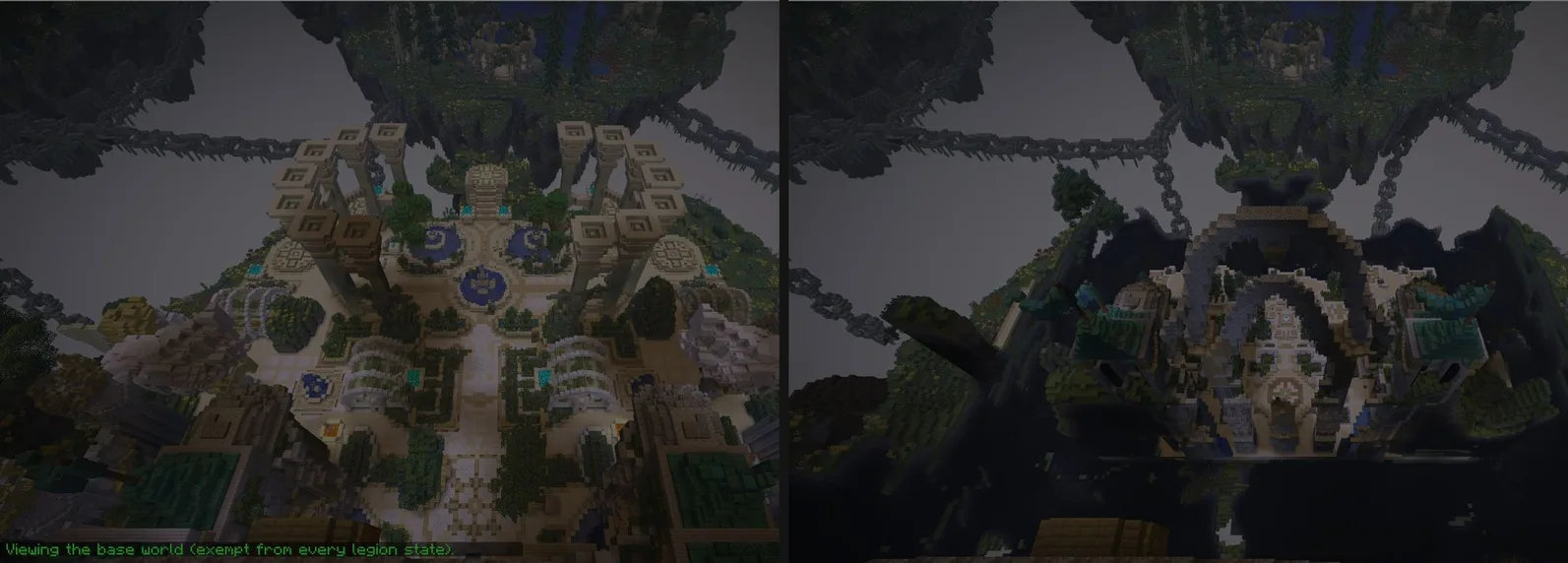
Gardens shows the packet-level side. Every legion sees its own version of the same islands: the server patches a per-legion block overlay into the chunk packets each player receives, so two players standing in one spot see different builds.
Why it’s here
The research projects show how I think. Arcane shows that I finish, maintain, and ship to a live server, and that I can carry a system far past the demo.
← Back to all work